Convert OBJ Meshes to COLLADA for DCC Tool Pipelines
Convert Wavefront OBJ files to DAE (COLLADA) and make them ready for Unity, Blender, Cinema 4D, and any DCC pipeline that requires the structured XML-based COLLADA format.
Convert Now
Convert OBJ to DAE
Upload a OBJ file and download the converted DAE — all processing happens on the server.
Drop your OBJ file here
or click to browse
Accepts .obj files
OBJ to COLLADA for DCC Pipelines
OBJ is one of the most portable 3D formats, but many DCC tools and game engines import COLLADA more reliably. Converting OBJ to DAE gives you a structured XML scene that preserves geometry, materials, and UV maps in a format understood by Unity, Blender, Cinema 4D, and Maya.
Convert Now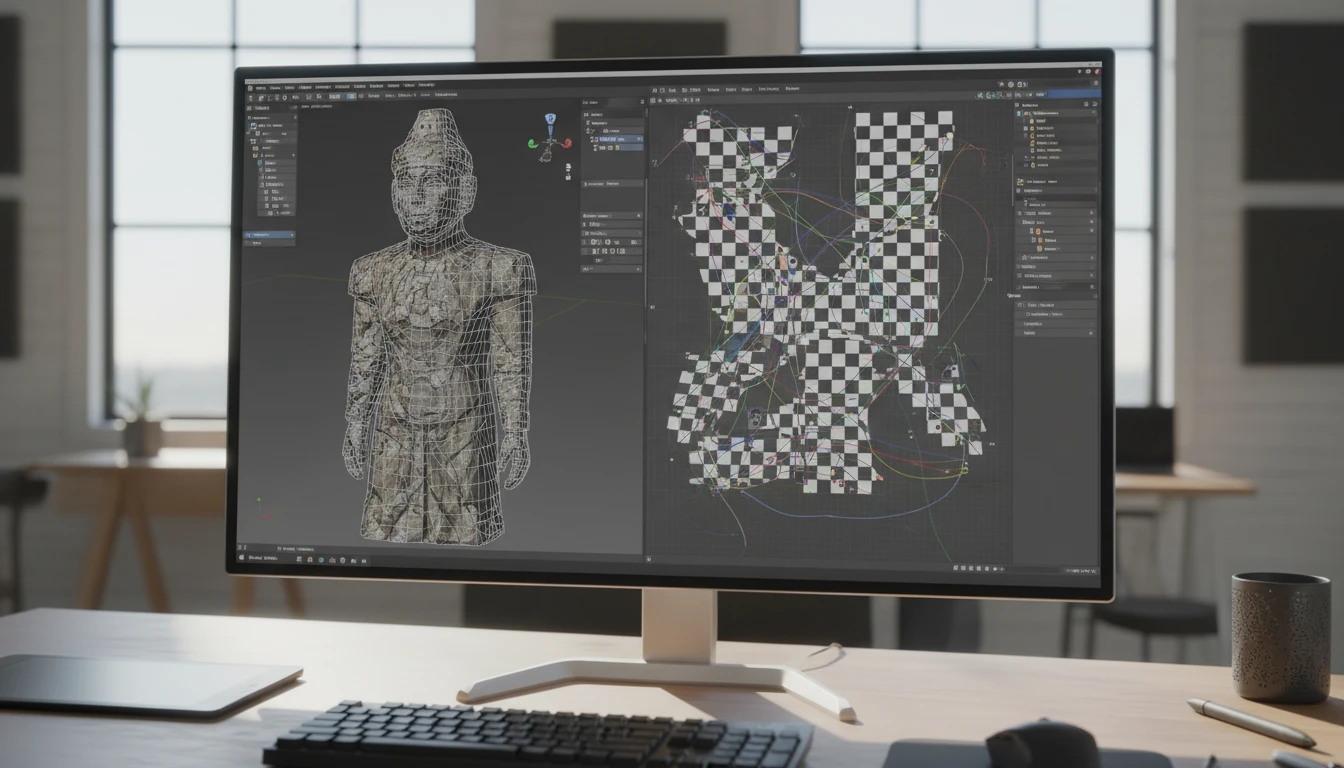
Materials and UVs Preserved
The converter reads the OBJ geometry and its companion MTL file, then writes COLLADA material definitions and UV texture coordinates into the DAE output. Your mesh arrives in the target DCC tool ready for texture assignment without manual UV re-mapping.
Convert Now
Unity and Blender Compatible
Unity natively imports DAE files from the Assets folder, and Blender's built-in COLLADA importer handles the output directly. Convert OBJ to DAE to streamline your asset import workflow in both tools without plugin dependencies.
Convert NowHow to Convert OBJ to DAE
Upload Your OBJ File
Drag and drop an OBJ file into the upload zone or click to browse. Files up to 100 MB are supported.
Sign In and Convert
Sign in to start the conversion. The server parses the OBJ geometry and MTL material definitions, then writes them into a COLLADA DAE document.
Download the DAE
Once ready, click Download. The DAE file is immediately importable into Unity, Blender, Cinema 4D, Maya, or any COLLADA-compatible DCC tool.
Deep Dive
OBJ and DAE: Portable Mesh vs. Structured Scene
Why Use It
No Software to Install
The conversion runs on the server. No Blender Python scripts, no FBX Converter, no local Assimp CLI pipelines needed. Upload and download directly from your browser.
Materials and UVs
OBJ MTL material definitions and UV texture coordinates are read and written into the COLLADA output, keeping your mesh ready for texture assignment in the target DCC tool.
DCC Tool Ready
The output DAE is immediately importable into Unity, Blender, Cinema 4D, and Maya without additional conversion or plugin dependencies.
Structured Scene Format
COLLADA's XML scene structure preserves geometry grouping and material bindings in a human-readable format that DCC tools and game engines parse reliably.
Who Uses It
Who Converts OBJ to DAE
Frequently Asked Questions
What is the DAE (COLLADA) file format?
DAE stands for Digital Asset Exchange and is the file extension for COLLADA, a Khronos-developed XML interchange format for 3D assets. It stores geometry, materials, textures, animations, cameras, lights, and scene hierarchy in a single structured document, and is supported by Unity, Blender, Cinema 4D, Maya, and most DCC tools.
Does the converter include material definitions from the MTL file?
Yes. If an MTL file accompanies the OBJ, the converter reads material names, diffuse colors, and texture references, and writes them as COLLADA material definitions in the DAE output.
Are UV texture coordinates preserved?
Yes. UV coordinates stored in the OBJ file are written into the COLLADA geometry as texture coordinate sets, keeping your UV mapping intact for texture assignment in the target DCC tool.
Which tools can open the resulting DAE file?
Unity, Blender, Cinema 4D, Maya, 3ds Max, SketchUp, and most other DCC tools import DAE files natively. You can also open DAE files in online COLLADA viewers or convert them further with Assimp.
What is the maximum OBJ file size?
The converter supports OBJ files up to 100 MB. Large OBJ files with millions of vertices produce correspondingly large DAE outputs due to the verbose XML structure of COLLADA.
Convert Your OBJ File to DAE Now
Upload your OBJ mesh and get a COLLADA DAE in seconds. No install, no manual steps.