Read Any Script Smoothly Without Losing Eye Contact
Paste your script, adjust scroll speed, font size, colors, and alignment, then go fullscreen for a distraction-free, auto-scrolling teleprompter — perfect for videos, speeches, and presentations.
Start Prompting
Teleprompter
Paste your script, adjust the speed and style, and go fullscreen for smooth, hands-free reading.
Your Script
Playback & Style
Enter your script here. This text will scroll automatically when you press play.
Keyboard shortcuts (in fullscreen)
- Space: Play / Pause
- Escape: Exit fullscreen
- Up Arrow: Increase speed
- Down Arrow: Decrease speed
How to use
- Enter your script in the text area above
- Adjust font size, colors, and alignment as needed
- Click Fullscreen for the best teleprompter experience
- Press Play to start scrolling text
- Use the speed slider or arrow keys to adjust scrolling speed
- Toggle Mirror Text if using a teleprompter mirror setup
Smooth Auto-Scrolling Script
Paste your script and press play. Text scrolls at a steady, adjustable pace using frame-based animation, so your pacing stays natural whether you are recording a video or rehearsing a speech.
Try It Now
Fullscreen Mode with Live Controls
Go fullscreen for an immersive, distraction-free prompter. A floating control bar lets you play, pause, adjust speed and size, and mirror the text without leaving fullscreen.
Try It Now
Custom Colors, Size, and Mirror Mode
Set the exact text color, background color, alignment, and font size that works best for your setup, and enable mirror mode for use with a physical teleprompter beam-splitter rig.
Customize NowStart prompting in three steps
Paste your script
Type or paste the text you want to read. Line breaks are preserved so your script displays exactly as written.
Adjust speed, size, and style
Set the scroll speed, font size, text color, background color, alignment, and mirror mode to match your reading pace and setup.
Go fullscreen and press play
Click Fullscreen for an immersive display, then press Play to start scrolling. Use Space to pause and the arrow keys to adjust speed on the fly.
Deep Dive
How the Online Teleprompter Works
Scrolling and rendering happen entirely in your browser using requestAnimationFrame — your script is never sent to a server.
Why Use This Teleprompter
Smooth, Adjustable Scrolling
Frame-based animation keeps pacing steady from 0.1x up to 10x speed.
Fullscreen Keyboard Control
Play, pause, and adjust speed with Space and arrow keys while presenting.
Fully Customizable Display
Set text color, background color, font size, alignment, and mirror mode.
100% Client-Side
Your script is rendered entirely in your browser and never uploaded anywhere.
Who Uses It
Who Uses This Teleprompter
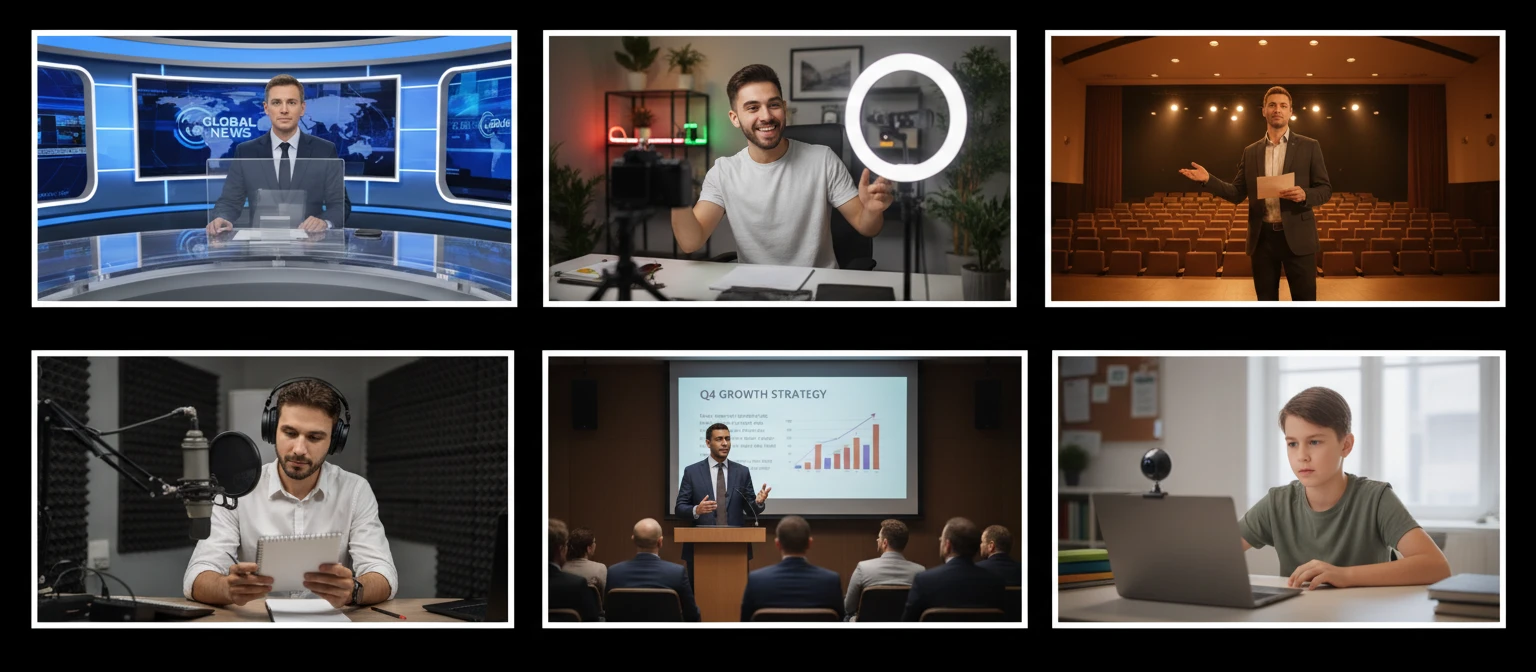
Anyone who needs to deliver prepared text while keeping eye contact with a camera or audience.

Frequently Asked Questions
How does the online teleprompter work?
Our teleprompter displays your text in a smooth scrolling format that you can control. Simply paste your script, adjust the speed and font settings to your preference, and start the prompter. You can pause, speed up, or slow down the scrolling at any time.
Is there a text length limit?
The teleprompter can handle scripts of various lengths, but for optimal performance, we recommend scripts under 10,000 words. Longer scripts may affect scrolling smoothness depending on your device.
Can I control the scrolling speed?
Yes, you can adjust the scrolling speed before starting and change it in real-time while the teleprompter is running, including with the Up and Down arrow keys in fullscreen. This allows you to match the pace to your speaking style or make adjustments on the fly.
Can I customize the appearance of the teleprompter?
Yes, you can adjust font size, text color, background color, text alignment, and mirror mode to create the most comfortable reading experience for your needs and environment.
Why would I need an online teleprompter?
An online teleprompter is useful for many purposes: recording videos, practicing speeches, delivering presentations, reading scripts for podcasts, or any situation where you need to deliver prepared text while maintaining eye contact with your audience or camera.
Do you store my scripts after I use the teleprompter?
No, we don't store any of your text. Since the teleprompter runs entirely in your browser, your content never reaches our servers. Once you close the browser tab or navigate away, all text is automatically cleared from your browser's memory.
Ready to Read Your Script Like a Pro?
Paste your script, adjust the settings, and go fullscreen for a smooth, confident delivery.