Import Your Opus Audio Directly into iTunes, Apple Music, and GarageBand
Upload your Opus file and get an M4A that drops straight into your iTunes library, syncs to iPhone and iPad, opens as a GarageBand track, and plays natively across the entire Apple ecosystem — no workarounds, no third-party apps.
Convert Now
Audio Format Converter
Upload any audio file, choose an output format, and download the converted result. Supports MP3, WAV, FLAC, AAC, OGG, ALAC, WMA, Opus and M4A.
Drop your audio file here
or click to browse
Add Opus Recordings to Your iTunes or Apple Music Library
iTunes and Apple Music on Mac and Windows import M4A files directly — drag the file into the library and it appears in your collection, syncs to iPhone and iPad, and plays with full metadata support. Opus files are not recognized by iTunes or Apple Music and will not import. Converting to M4A is the only way to bring Opus audio into Apple's music management ecosystem.
Convert Now
Open Opus Recordings as GarageBand Tracks
GarageBand on Mac and iPad imports M4A audio files directly into projects as audio regions. Podcast producers who record interviews via Discord or WebRTC receive Opus files that GarageBand cannot open. Converting to M4A lets you drop the recording straight into a GarageBand project for editing, adding music beds, applying EQ, and exporting to any format.
Try It Now
Sync Opus Recordings to iPhone and iPad
Syncing audio files to iPhone via iTunes or Finder requires M4A or MP3 format. Opus files cannot be synced as music or voice files through Apple's device management. Converting to M4A lets you add Opus recordings — interviews, podcast drafts, Discord voice captures — to a device sync plan and access them offline in the iPhone Music app.
See It in ActionThree steps to an iTunes-ready M4A file
Upload your Opus file
Drop your .opus file onto the tool or click to browse. Files from Discord exports, WebRTC recordings, and Opus-based VoIP tools are all accepted.
Convert to M4A
Click "Convert". FFmpeg decodes the Opus stream and re-encodes it as AAC inside an MPEG-4 container, producing a standard .m4a file at a high bitrate.
Download your M4A file
Download your .m4a file and drag it into iTunes, Apple Music, or GarageBand — or AirDrop it directly to an iPhone or iPad.
Deep Dive
Opus vs M4A: Streaming Codec vs Apple Music Container
Opus is engineered for real-time streaming. M4A is Apple's music container — the format iTunes, Apple Music, GarageBand, and iOS use natively. Here is the full picture.
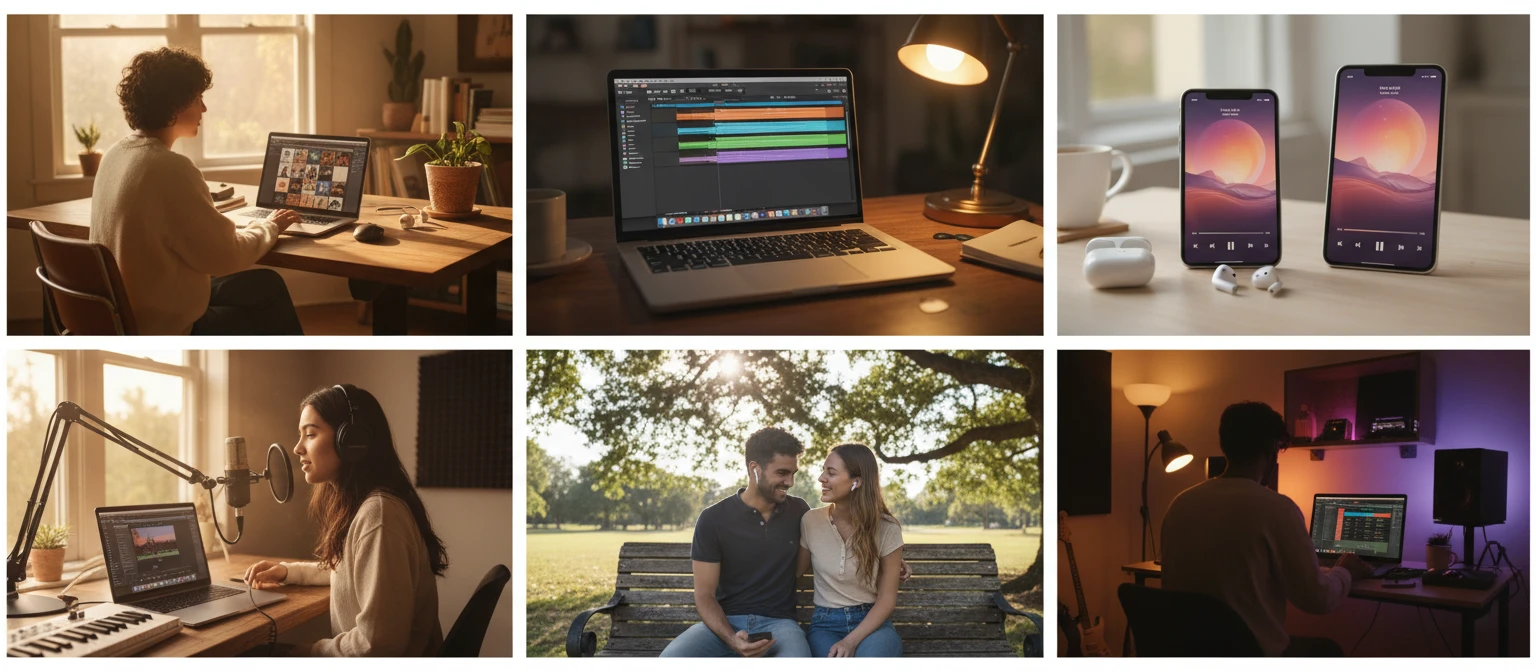
Our converter uses FFmpeg to decode Opus and re-encode as AAC in an M4A container at a high bitrate, minimizing transcoding quality loss.
Why Convert Opus to M4A
iTunes and Apple Music Ready
M4A imports directly into iTunes and Apple Music — drag and drop into the library and sync to any Apple device.
Opens in GarageBand and Logic Pro
Drop the M4A into a GarageBand or Logic Pro project as an audio region ready to edit, mix, and export.
Syncs to iPhone and iPad
M4A files sync to iPhone and iPad via iTunes or Finder and play natively in the iOS Music app without any extra app.
Fast Conversion
Most Opus files convert to M4A in under 30 seconds on dedicated FFmpeg servers.
Who Uses It
Who Converts Opus to M4A
iTunes and Apple Music library managers, GarageBand podcast editors, iPhone users wanting to sync recordings, and anyone moving Opus audio from a streaming or voice platform into Apple's music ecosystem.

Converts using FFmpeg on dedicated servers.
Frequently Asked Questions
Why can't I import Opus directly into iTunes or Apple Music?
iTunes and Apple Music only recognize audio formats in Apple's supported list, which includes AAC (.m4a), MP3, WAV, AIFF, and Apple Lossless (.m4a). Opus is not on that list. The only way to bring Opus audio into iTunes or Apple Music is to convert it to a supported format first. M4A with AAC encoding is the closest match to what Apple's ecosystem natively handles.
Can I open the converted M4A in GarageBand on iPad?
Yes. GarageBand on both Mac and iPad imports M4A audio files. On iPad, you can use the Files app to open the M4A file and share it directly into GarageBand. The audio will appear as an audio region in the project, ready to edit, trim, and mix.
What is the difference between M4A and AAC?
AAC is the audio codec — the algorithm that compresses and decompresses the audio. M4A is the container file format that holds AAC audio. Every M4A file from an Apple source contains AAC inside. Converting Opus to M4A encodes the audio as AAC and packages it in the M4A container, which is what iTunes, Apple Music, and GarageBand expect.
Will converting Opus to M4A cause quality loss?
A small quality penalty occurs because both Opus and AAC (inside M4A) are lossy codecs. Decoding Opus and re-encoding as AAC introduces a second compression pass. Using a high AAC output bitrate (128 kbps or above for music, 64 kbps for voice) keeps this additional penalty minimal and undetectable in most listening scenarios.
Can I AirDrop the converted M4A to an iPhone?
Yes. AirDrop transfers M4A files to iPhone and they open directly in the Files app or can be saved to Apple Music. This is the fastest way to move a converted Opus recording to an iPhone without a cable sync.
Is there a file size limit?
The upload limit is 100 MB per file. Most Opus audio files are well within this limit.
Ready to Convert Your Opus to M4A?
Upload your file above and get an iTunes-ready M4A file in seconds.