Analyze Any Song — Lyrics and Music in One Report
Upload any audio file or record live. Get a complete dual analysis: lyrical summary, themes, emotional moods, language, and explicit flag — alongside genres, subgenres, musical moods, and instruments.
Analyze a Song
Analyze Any Song
Add an audio file and we'll open AI Music Studio with it ready for a full lyric and music analysis.
Drag & drop your audio here
or click to browse — MP3, WAV, FLAC, up to 50MB
Get timestamped lyrics, themes, genres, structure, instrumentation, tempo, key and production details.
Sample analysis
What your song report looks like
Lyrics Analysis
📝
Music Analysis
🎵
Lyrics — Summary
The lyrics narrate a journey of personal liberation, moving from a state of enforced silence and self-restraint to one of outward expression and boldness. The narrator describes a past defined by "turning down the gain" and concealing their true self, metaphorically represented by painting walls white to avoid facing reality. The emotional arc follows a transition from hesitation and fear to an empowered, vocal presence, emphasizing the act of breaking free from internal and external constraints to finally "write the song" of their own life.
Lyrics — Detail
- Moods
- Introspective, Determined, Liberated, Resilient
- Themes
- Self-discovery, Authenticity, Overcoming Fear, Breaking Silence
- Language
- English
- Explicit
- No
Lyrics — Timestamped
- Verse 1
- [0:19] I spent a lifetime turning down the gain
- [0:22] Keeping all the static inside my brain
- [0:26] The walls in this room were painted in white
- [0:30] So I wouldn't have to face the color of the light
- [0:34] I kept my rhythm tied behind my back
- [0:37] Tracing shadows in the pavement crack
- [0:41] Waiting for a signal that was never gonna land
- [0:45] While the hourglass was slipping through my hand
- Chorus
- [0:49] But there's a hum beneath the floorboards now starting to break through the hollow vowel
- [0:52] I'm shaking off the silence like a heavy coat, there's a brand new melody inside my throat
- [0:56] I'm turning the dial, I'm finding the key
- [0:59] Letting the frequency finally break free
- [1:02] No more whispering into the dark
- [1:05] I'm igniting the fuels, I'm chasing the spark
- [1:08] Yeah, I'm unmuted, I'm taking the floor
- [1:11] I'm not the ghost I was before
- [1:14] Louder than the doubt, higher than the haze
- [1:18] I'm writing this song for the rest of my days
- Verse 2
- [1:21] The mirror doesn't look the same these days
- [1:24] It's clearing out the smoke, it's clearing the maze
- [1:28] Every jagged note I used to be afraid to sing is becoming the tether, is becoming the wing
- [1:36] I'm stepping out from behind the heavy door
- [1:39] Leaving all the hesitation on the floor
- [1:42] My pulse is a rhythm, my breath is a beat
- [1:46] Finding my footing on a crowded street
- Bridge
- [1:51] Fate told me keep it steady, keep it low
- [1:54] Don't let the fire start to overflow
- [1:58] But a quiet light is a cage made of glass
- [2:01] And I'm throwing the stone, watch the pieces pass
- [2:04] Watch it shatter, watch it fly
- [2:09] Painting my colors across the sky
- Chorus
- [2:13] I'm turning the dial, I'm finding the key
- [2:16] Letting the frequency finally break free
- [2:19] No more whispering into the dark
- [2:22] I'm igniting the fuels, I'm chasing the spark
- [2:25] Yeah, I'm unmuted, I'm taking the floor
- [2:28] I'm not the ghost I was before
- [2:31] Louder than the doubt, higher than the haze
- [2:35] I'm writing this song for the rest of my days
Music — Genres & Mood
- Genres
- Pop (85), Alternative (75), Synth-pop (70)
- Subgenres
- Indie Pop (80), Electropop (75), Synthwave-influenced (60)
- Moods
- Anthemic (85), Driven (80), Uplifting (75)
- Era / Decade
- Contemporary 2020s
Music — Structure
- [0:00–0:18] Intro — Atmospheric synth pad with rhythmic pulses.
- [0:19–0:48] Verse 1 — Bass-driven, steady beat, vocals are intimate and controlled.
- [0:49–1:20] Chorus — Full instrumentation, driving energy, anthemic vocal delivery.
- [1:21–1:50] Verse 2 — Rhythmic development, layered percussion, more dynamic vocal range.
- [1:51–2:12] Bridge — Stripped back, tension building with rising synth melodies.
- [2:13–2:37] Chorus — Return to full intensity.
- [2:38–3:09] Outro — Fading synths and final vocal ad-libs.
Music — Instrumentation
- Lead Vocals — Clean, expressive, gradually increasing in volume and intensity.
- Synthesizers — Used for textures, arpeggios, and rhythmic pulses.
- Bass Guitar (Synth-based) — Pulsing, driving, and dominant in the mix.
- Drum Kit — Crisp, programmed-style drums with a punchy snare.
Music — Production & Sonic Details
- Tempo
- 118 BPM
- Key
- C Major
- Time Signature
- 4/4
- Production Style
- Polished, modern pop production
- Mix Characteristics
- Punchy, wide stereo field, clear separation of elements
- Notable Effects
- Sidechain compression on synths, light saturation, vocal layering in the chorus
- Energy Level
- Variable — builds from medium to high
- Danceability
- High

Lyrics Decoded — Themes, Moods, and Context
The lyrics analysis section opens with a flowing summary of the song's narrative and emotional arc, capturing the central story, imagery, and meaning. It then lists the dominant moods expressed in the words (e.g. "Nostalgic, Defiant, Introspective") and the core themes (e.g. "Identity, Loss, Resilience"). The language is detected automatically, and the explicit flag tells you at a glance whether the lyrics contain mature content. This makes the tool useful for parents, playlist curators, music teachers, and anyone who wants to understand a song beyond its surface.
Analyze Song Lyrics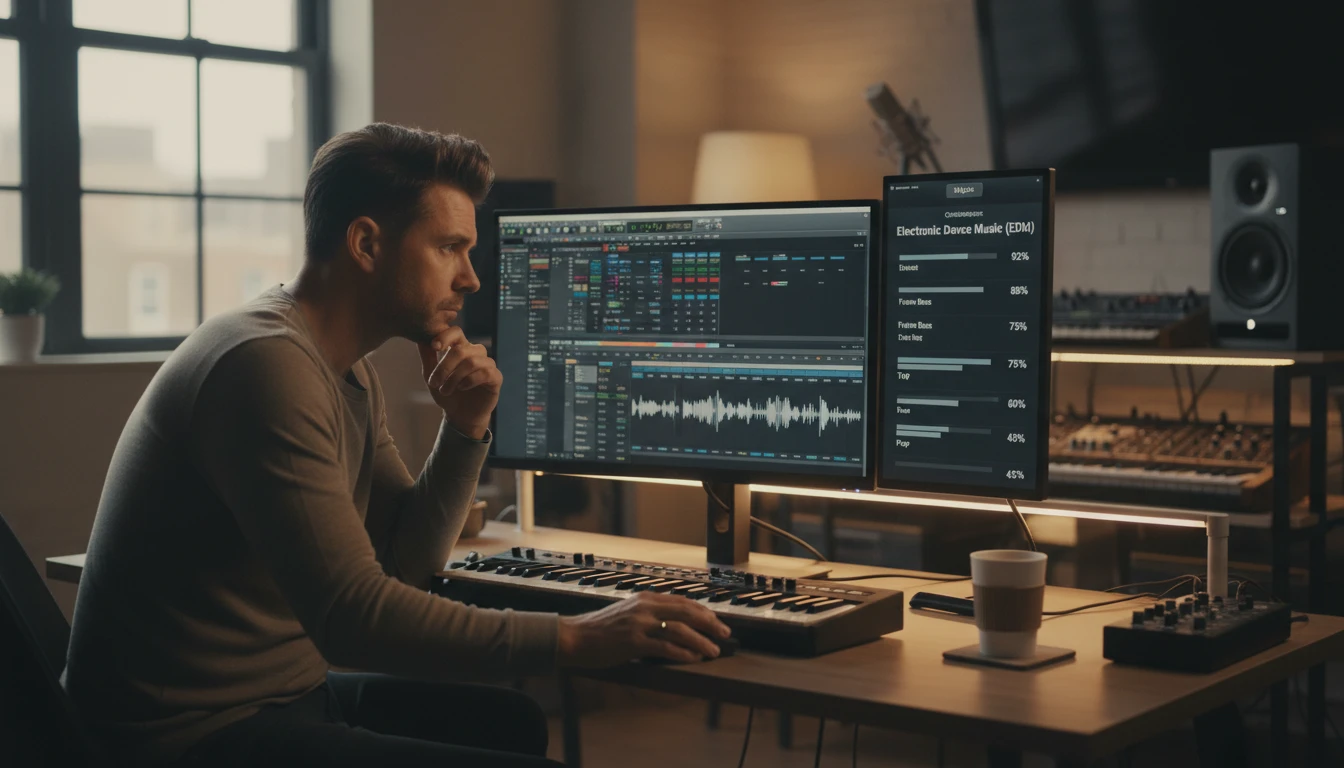
Genre and Subgenre with Confidence Scores
The music analysis goes beyond a single genre label. It identifies the top 3 to 5 genres the track fits, each with a confidence score out of 100, so you can see whether a song is firmly in one genre or blends several. The subgenre breakdown goes further — identifying specific niches like "Post-Rock," "Synth-Pop," or "Gothic Rock" with their own confidence scores. This gives producers, DJs, playlist curators, and music writers a precise vocabulary for describing the sound.
Identify the Genre
Musical Moods and Instruments Detected
Separate from the lyrical moods, the musical mood section captures the sonic emotional quality of the track — how the music itself feels, independent of the words (e.g. "Energetic," "Melancholic," "Uplifting"). The instruments section lists every primary instrument and sound layer detected in the recording: drums, guitar, synthesizer, bass, vocals, strings, and more. Together these sections give you a complete sonic fingerprint of the song without needing to describe it yourself.
Detect InstrumentsHow to Analyze a Song
Record or Upload Your Song
Click Record and play the song into your microphone, or click Upload to select an MP3, WAV, M4A, OGG, WebM, or FLAC file. A 30-second clip is enough for reliable genre and mood identification; a full verse and chorus gives the best lyrical analysis.
Choose Your AI Model
Select the Basic model for most songs, or the Advanced model for complex arrangements, genre-blending tracks, or songs with dense lyrical content that needs deeper analysis.
Get Your Dual Analysis
Click Analyze Song and receive a complete report: lyrical summary, moods, themes, language, explicit flag — plus genres, subgenres, musical moods, and instruments all in one view.
Who Uses It

Music Students and Educators
Use the song analyzer to study lyrical craft, thematic construction, and genre characteristics in class or independently. Upload tracks from your curriculum and get a structured breakdown of themes, moods, and musical elements to use as a discussion framework. The genre and subgenre labels with confidence scores make it easy to understand how songs relate to musical traditions and movements.
Playlist Curators and DJs
Building a coherent playlist or DJ set requires understanding the mood and genre profile of every track. Use the song analyzer to quickly confirm the genre, subgenre, musical mood, and instruments for any song. The explicit flag helps you keep playlists family-friendly when needed. The confidence scores let you spot tracks that genuinely belong in a genre versus tracks that only loosely fit.
Songwriters and Producers
Analyzing reference tracks is a core part of songwriting and production. Upload a song that has the vibe you want to create and get a precise breakdown of its lyrical themes, moods, genres, subgenres, and instruments. Use this as a creative brief when collaborating: "The reference track has a Nostalgic, Defiant lyrical mood with a Post-Rock subgenre feel and Synth-Pop elements." This gives your collaborators exact language to work from.

Parents and Content Moderators
The explicit content flag gives a quick yes or no answer on whether a song contains mature language. Upload any track and get an instant answer alongside a lyrical summary that gives context about the themes and subject matter. This makes it easy to make informed decisions about age-appropriate music for children, classroom playlists, or family events without having to listen to every song in full.
Deep Dive
Getting the Most Accurate Song Analysis
Audio clarity, recording length, and lyrical audibility all affect how accurately the AI analyses a song. These tips help you get the most complete and useful report.
Note: Analysis accuracy varies based on audio clarity, recording length, and lyrical audibility. Songs with inaudible or heavily processed vocals will have reduced lyrical analysis detail. Genre confidence scores reflect stylistic fit, not certainty.
Why Use It
Lyrics and Music Together
One report covers both the lyrical content (summary, themes, moods, language, explicit flag) and the musical characteristics (genres, subgenres, moods, instruments).
Record or Upload
Record live audio from your browser microphone or upload MP3, WAV, M4A, OGG, WebM, or FLAC files. No extra software needed.
Genre Confidence Scores
Genres and subgenres are listed with confidence scores out of 100, so you can see exactly how strongly a song fits each style.
Instrument Detection
Every primary instrument and sound layer in the recording is identified — drums, guitar, synthesizer, bass, vocals, strings, and more.
Frequently Asked Questions
What does the AI Song Analyzer identify?
The tool produces a dual analysis in one report. The lyrics section covers: a flowing summary of the song's narrative and themes, a list of emotional moods expressed in the lyrics, core themes or subjects, the language of the lyrics, and whether the song contains explicit content. The music section covers: the top genres with confidence scores, specific subgenres with confidence scores, musical moods based on the sonic character, and the primary instruments detected.
What audio formats are supported?
MP3, WAV, M4A, OGG, WebM, and FLAC are all supported. You can also record directly in the browser, which creates a WebM audio file automatically. WAV and FLAC are lossless formats that produce the most detailed analysis. For the best lyrical analysis, include at least one verse and chorus — around 60 to 90 seconds.
What is the explicit content flag?
The explicit flag is a simple Yes or No that appears in the lyrics analysis section. It reflects whether the lyrics heard in the uploaded audio contain explicit language, profanity, or mature content. This is based on the lyrics audible in the specific audio clip uploaded, not on the song's official explicit rating from a streaming platform.
What is the difference between lyrical moods and musical moods?
Lyrical moods reflect the emotions expressed by the words themselves — the feelings conveyed by the narrative, imagery, and lyrical content. Musical moods reflect the sonic and emotional character of the music: the instrumentation, tempo, production style, and arrangement. A song can have melancholic lyrics set to energetic, upbeat music, or joyful words over a minor-key, somber arrangement. The analysis separates these so you can understand both dimensions of the song.
What do the genre confidence scores mean?
Confidence scores reflect how strongly the song matches each genre label out of 100. A score of 85 means the song strongly exhibits the core characteristics of that genre. A score of 60 means the song shows some characteristics of that genre alongside significant influence from other styles. Multiple high scores across different genres accurately reflect a genre-blending track rather than forcing a single label.
Does it work for instrumental songs?
Yes. For instrumental tracks, the lyrics section will correctly note that no audible lyrics were detected and mark the language as "Instrumental / No Lyrics." The music analysis section — genres, subgenres, moods, and instruments — runs in full and is unaffected by the absence of vocals.
How does duration-based pricing work?
The basic model costs 5 credits per minute of audio with a minimum of 10 credits. The advanced model costs 10 credits per minute with a minimum of 20 credits. Duration is rounded up to the nearest full minute. The estimated credit cost is displayed before you click Analyze Song so you can confirm before spending credits.
Analyze Any Song Instantly
Sign up free and get 100 credits instantly. Upload any song and get a complete lyrics and music analysis in seconds.
Disclaimer: This tool uses generative AI technology which may produce content that resembles copyrighted materials or that is inaccurate, incomplete, or out-of-date. It is provided for general information and educational purposes only and is not intended for illegal activities or to replace professional advice, diagnosis, or treatment. Users are solely responsible for how they use the generated content. If you plan to use AI-generated content commercially or publicly, we strongly recommend reviewing it for potential copyright issues and obtaining proper permissions where necessary. We accept no liability for copyright infringement or any other consequences resulting from the use of content generated by this tool.