Write a Finished Poem on Any Subject in Any Style
Describe your subject, choose a poetry style and mood, and get a complete poem with craft notes explaining the imagery and literary devices used.
Write a Poem
AI Poem Writer
Describe any subject or feeling and get a finished poem. Choose from eight poetry styles (sonnet, haiku, limerick, villanelle, and more), eight moods, and three length options.
Results
AI Poem Writer
AI Poem Writer
Paste your text on the left and click the button to see the results.
- A complete, finished poem on any subject
- Eight styles: free verse, sonnet, haiku, limerick, ode, ballad, acrostic, villanelle
- Eight moods: reflective, romantic, melancholic, joyful, inspirational, dark, humorous, peaceful
- Three lengths: short (1–2 stanzas), medium (3–4), long (5–6)
- Craft notes on imagery, structure, and literary devices used
- Two variation ideas for further exploration

Eight Styles, Each with Its Own Rules and Character
Poetry style is not decoration — it shapes how meaning is made. A haiku's 5-7-5 syllable constraint forces precision: every syllable must earn its place, and the juxtaposition between the two images creates the meaning. A sonnet's 14-line ABAB CDCD EFEF GG structure channels argument toward a volta — a turn — that changes the reader's understanding. A limerick's AABBA rhyme and anapestic rhythm creates comic timing. A villanelle's two repeating refrains give obsessive weight to the lines that return. Each style is a different instrument playing the same subject — and each produces a fundamentally different kind of poem.
Write a Poem Now
Specific Imagery Over Generic Sentiment
The most common failure in AI-generated poetry is generic sentiment: "love fills my heart," "the stars shine bright," "hope carries me forward." These lines say nothing specific and therefore say nothing at all. Good poetry works through concrete, specific images — the grandmother's hands described in exact detail, the particular quality of light at 5am in a city, the exact sound a door makes when it closes for the last time. The tool is designed to write toward specific imagery — never using clichéd opening lines, never stacking abstract nouns, always finding the precise sensory detail that makes the feeling real for the reader.
See the Difference
Craft Notes That Explain the Choices
Every generated poem includes craft notes explaining three specific decisions: what imagery was chosen and why, how the line breaks and stanza structure create effect, and which literary device is most effective in this poem — named, located in a specific line, and explained. These notes help you evaluate the poem, understand what makes it work, and learn from the craft decisions if you are developing your own writing. They also make the output useful for writing teachers who want to demonstrate specific techniques.
Read the Craft NotesHow to Write a Poem
Describe Your Subject
Describe what you want the poem to be about — a person, a feeling, a moment, a place, an occasion. The more specific and personal, the more resonant the poem. A sentence or two is enough; a detailed description gives the AI more to work with.
Choose Style, Mood, and Length
Select the poetry style (free verse, sonnet, haiku, limerick, ode, ballad, acrostic, or villanelle), the mood (reflective, romantic, melancholic, joyful, inspirational, dark, humorous, or peaceful), and the length (short, medium, or long).
Get the Finished Poem
Receive the complete poem, craft notes explaining the literary choices, and two variation suggestions. Use it as-is, edit it, or use it as a starting point for your own writing.
Who Uses It

Personal Gifts and Special Occasions
Write a poem for a birthday, wedding, anniversary, graduation, retirement, or memorial. Describe the person, the relationship, and what you want the poem to express — the tool writes a personal, specific poem that reads like it was written by someone who knew them. Far more meaningful than a card.

Writers and Poets Looking for a Starting Point
Generate a first draft and then rewrite it in your own voice. Use the craft notes to identify what is working and what is not. Try the two variation suggestions to explore different angles. Use the haiku or acrostic styles to constrain yourself productively when writer's block strikes.

Students and Creative Writing Classes
Generate poems in specific forms — sonnet, villanelle, haiku — to study how the form works. Use the craft notes to identify literary devices for analysis. Generate poems on the same subject in different styles to compare how form shapes meaning. Use as a reference, not as submission text.

Content Creators and Social Media
Generate short poems — haiku, short free verse, short ode — for social media posts, newsletters, or website content. A well-crafted haiku on a relevant theme creates engagement that blocks of prose cannot. Use the humorous or joyful mood with a limerick for playful brand voice content.
Deep Dive
What Makes a Poem Work
Understanding the craft of poetry helps you evaluate the generated output and develop your own eye for what works and why.
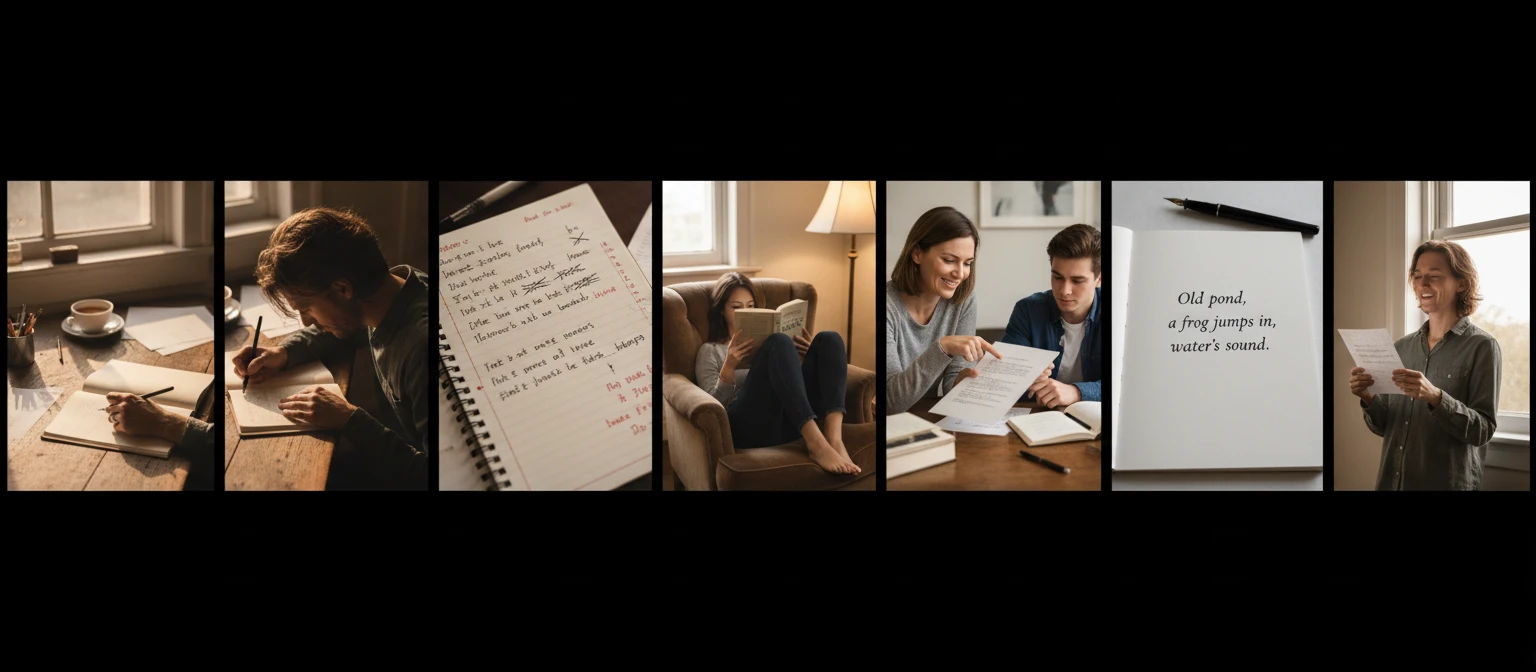
Note: AI-generated poems are a strong starting point. Edit freely — change words, break lines differently, cut stanzas that do not work. The best poems come from the dialogue between the generated draft and your own revision.
Why Use It
Eight Poetry Styles
Free verse, sonnet, haiku, limerick, ode, ballad, acrostic, and villanelle — each style follows its proper form and creates a different kind of poem.
Specific, Not Generic
Written toward concrete imagery and precise language — never clichéd opening lines, never abstract sentiment stacked on abstract sentiment.
Craft Notes Included
Explains the imagery choices, the structural approach, and the most effective literary device — named, located in the poem, and analyzed.
Eight Moods, Three Lengths
Reflective, romantic, melancholic, joyful, inspirational, dark, humorous, or peaceful — paired with short, medium, or long length control.
Frequently Asked Questions
Which poetry style should I choose?
Free verse is the most flexible — no fixed rhyme or metre, relying on imagery and line breaks for effect. Haiku is ideal for a single precise moment or image (5-7-5 syllables). Sonnet works for complex arguments or emotions that need to build toward a turn. Limerick is for humorous content. Villanelle is for subjects that deserve obsessive, repeated emphasis — grief, longing, obsession. Ode for celebration. Ballad for narrative. Acrostic when you want the subject's name or a word spelled by the first letters of each line.
How specific should my subject description be?
Very specific. "A love poem" will produce a generic poem. "A poem about the way my partner always leaves a light on for me when I work late — the specific feeling of seeing that light in the window when I come home" will produce a poem with real resonance. Describe the specific person, moment, place, or feeling — not the category it belongs to.
Can I use the generated poem as a personal gift?
Yes. Generated poems are original and not copied from any other source. Include the recipient's name, specific memories, or characteristic details in your subject description and the poem will read as if it were written specifically for them — because the AI generates it from your specific description.
Does the haiku follow the 5-7-5 syllable structure?
Yes. The haiku style specifically instructs the AI to follow the 5-7-5 syllable structure across three lines, using present-tense nature imagery and juxtaposition — the classic elements of the form. If you count the syllables and find a discrepancy, the Advanced model is more reliable for precise syllable counting in constrained forms.
Can I edit the generated poem?
Absolutely — and you should. The best approach is to use the generated poem as a first draft: change words that feel wrong, break lines differently, cut stanzas that do not work, and add details from your own experience. The craft notes will help you understand what is working and where to focus your edits.
Write Your First Poem Instantly
Sign up free and get 100 credits instantly. Describe any subject and get a finished, emotionally resonant poem in seconds.
Disclaimer: This tool uses generative AI technology which may produce content that resembles copyrighted materials or that is inaccurate, incomplete, or out-of-date. It is provided for general information and educational purposes only and is not intended for illegal activities or to replace professional advice, diagnosis, or treatment. Users are solely responsible for how they use the generated content. If you plan to use AI-generated content commercially or publicly, we strongly recommend reviewing it for potential copyright issues and obtaining proper permissions where necessary. We accept no liability for copyright infringement or any other consequences resulting from the use of content generated by this tool.