Make Your AAC Audio Play on Every Device and Platform
Upload your AAC file and download an MP3 that works on every car stereo, Bluetooth speaker, legacy player, and sharing platform without exception.
Convert Now
Audio Format Converter
Upload any audio file, choose an output format, and download the converted result. Supports MP3, WAV, FLAC, AAC, OGG, ALAC, WMA, Opus and M4A.
Drop your audio file here
or click to browse

Works on Every Car Stereo and Bluetooth Speaker
Older car audio systems, aftermarket head units, and many Bluetooth speakers only read MP3 from USB drives or SD cards. Converting your AAC files to MP3 guarantees playback without format errors or silent tracks.
Convert Now
Upload to Any Platform Without Rejection
Podcast hosts, royalty-free music stores, DJ pool services, and many content platforms specify MP3 as their required upload format. Converting first avoids submission errors and re-upload loops.
Try It Now
FFmpeg-Powered Server Conversion
Every conversion runs through FFmpeg on dedicated servers. The AAC stream is fully decoded to PCM first, then re-encoded to MP3 at a high bitrate to minimize the quality penalty of transcoding between two lossy formats.
See It in ActionThree steps to universal compatibility
Upload your AAC file
Drop your AAC or M4A file onto the tool or click to browse. The format is validated before conversion starts.
Convert to MP3
Click "Convert". FFmpeg decodes the AAC stream to PCM and re-encodes it as MP3 at a high bitrate to preserve as much quality as possible during transcoding.
Download your MP3 file
Preview the output in the browser player, then download your .mp3 file ready for any device or platform.
Deep Dive
AAC vs MP3: When Compatibility Wins Over Efficiency
AAC is the more efficient codec but MP3 is the most universally supported audio format ever created. Here is what matters when choosing between them.
Our converter uses a high-quality MP3 encoder setting to minimize quality loss during AAC-to-MP3 transcoding.
Why Use This Converter
Plays on Every Device
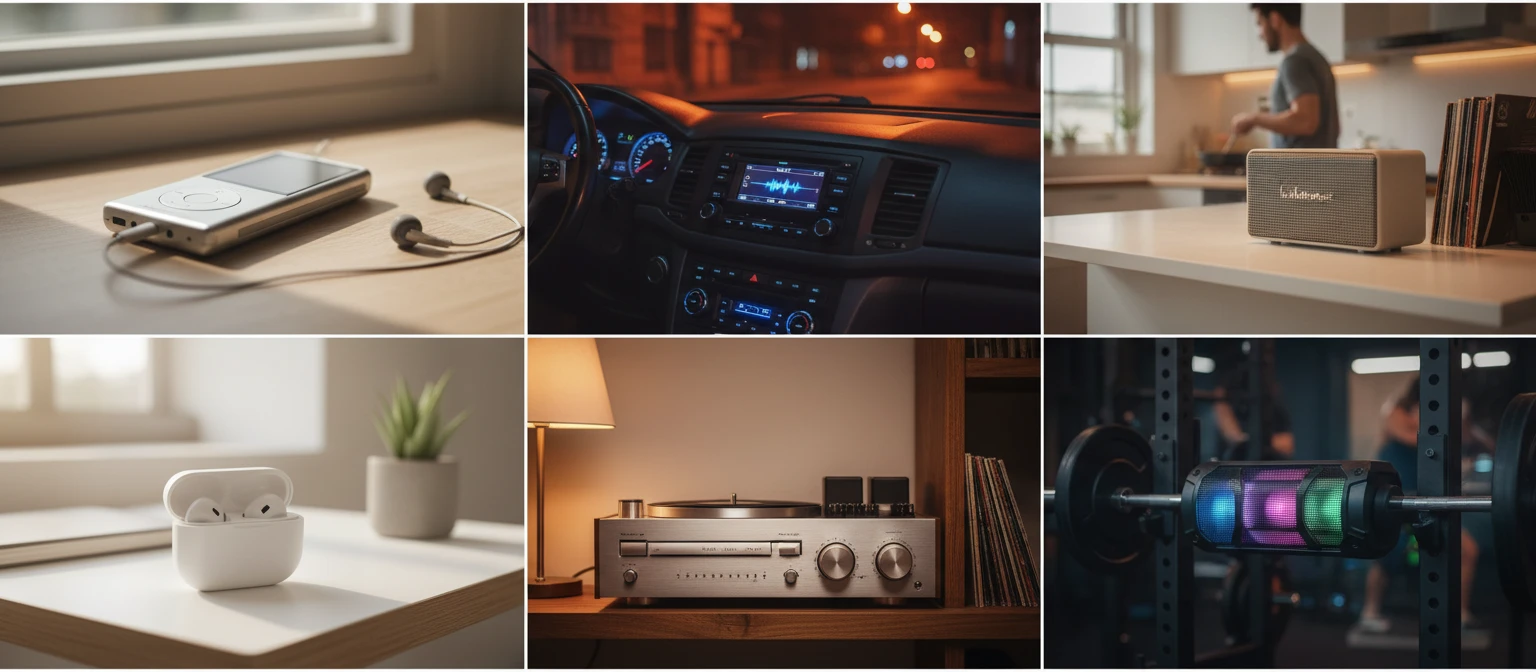
MP3 is recognized by every smartphone, car stereo, Bluetooth speaker, smart TV, and media player without any codec installation.
Fast Conversion
Most AAC files convert to MP3 in under 30 seconds on our dedicated servers.
High-Quality Transcoding
FFmpeg decodes the full AAC stream before re-encoding to MP3, using a high bitrate to keep quality loss to a minimum.
Podcast and Platform Ready
MP3 is the required upload format for most podcast hosts, royalty-free music stores, and content distribution platforms.
Who Uses It
Who Converts AAC to MP3
Anyone sharing audio outside the Apple ecosystem or uploading to a platform that requires MP3 has a reason to convert.

Converts using FFmpeg on dedicated servers.
Frequently Asked Questions
Will I lose quality when converting AAC to MP3?
Yes, a small amount of quality is lost because both AAC and MP3 are lossy formats. Converting between them requires decoding the AAC and re-encoding as MP3, which introduces a second round of compression. Using a high output bitrate (192 kbps or above) keeps this quality loss minimal and undetectable to most listeners.
Why would I convert from AAC to MP3 if AAC is technically better?
AAC is more efficient, but MP3 is more universally compatible. Older car stereos, legacy MP3 players, many Bluetooth speakers, and numerous upload platforms only recognize MP3. If your destination device or service does not support AAC, converting to MP3 is the practical choice.
What bitrate will the output MP3 use?
Our converter uses a high-quality bitrate setting to minimize the quality penalty of transcoding from AAC. This keeps the output close to the perceived quality of the source file while ensuring broad compatibility.
Can I convert M4A files containing AAC audio?
Yes. M4A is an MPEG-4 container that typically holds AAC audio. Upload your .m4a file the same way as an .aac file and the converter will decode the AAC stream and output an MP3.
Is there a file size limit?
The upload limit is 100 MB per file. Most AAC tracks are well within this limit.
What is the difference between AAC and M4A?
AAC is the audio codec. M4A is a container file that holds AAC-encoded audio. Think of M4A as the box and AAC as the audio inside. Both refer to the same underlying audio data and can be converted to MP3 the same way.
Ready to Convert Your AAC to MP3?
Upload your file above and get a universally compatible MP3 in seconds.